
Still Managing Your Business on Excel? Here's Why It Might Be Time for a Change
Excel has been a trusted business tool for decades. It is simple, familiar, and often the first solution businesses turn to when managing data, tracking operations, or organizing workflows.
In the early stages of a business, spreadsheets can work well. They help teams maintain records, monitor sales, manage inventory, and generate basic reports without significant investment in technology.
However, as businesses grow, their operational needs become more complex. More customers, more employees, and more processes inevitably lead to larger volumes of data and increased administrative effort.
The question is no longer whether Excel can manage your business today. The real question is whether it can support the business you aspire to build tomorrow.
When Growth Begins to Outpace Spreadsheets
Many organizations continue using spreadsheets simply because they have always done so. Over time, these files become deeply embedded into daily operations.
Yet growth introduces challenges that spreadsheets were never designed to handle effectively.
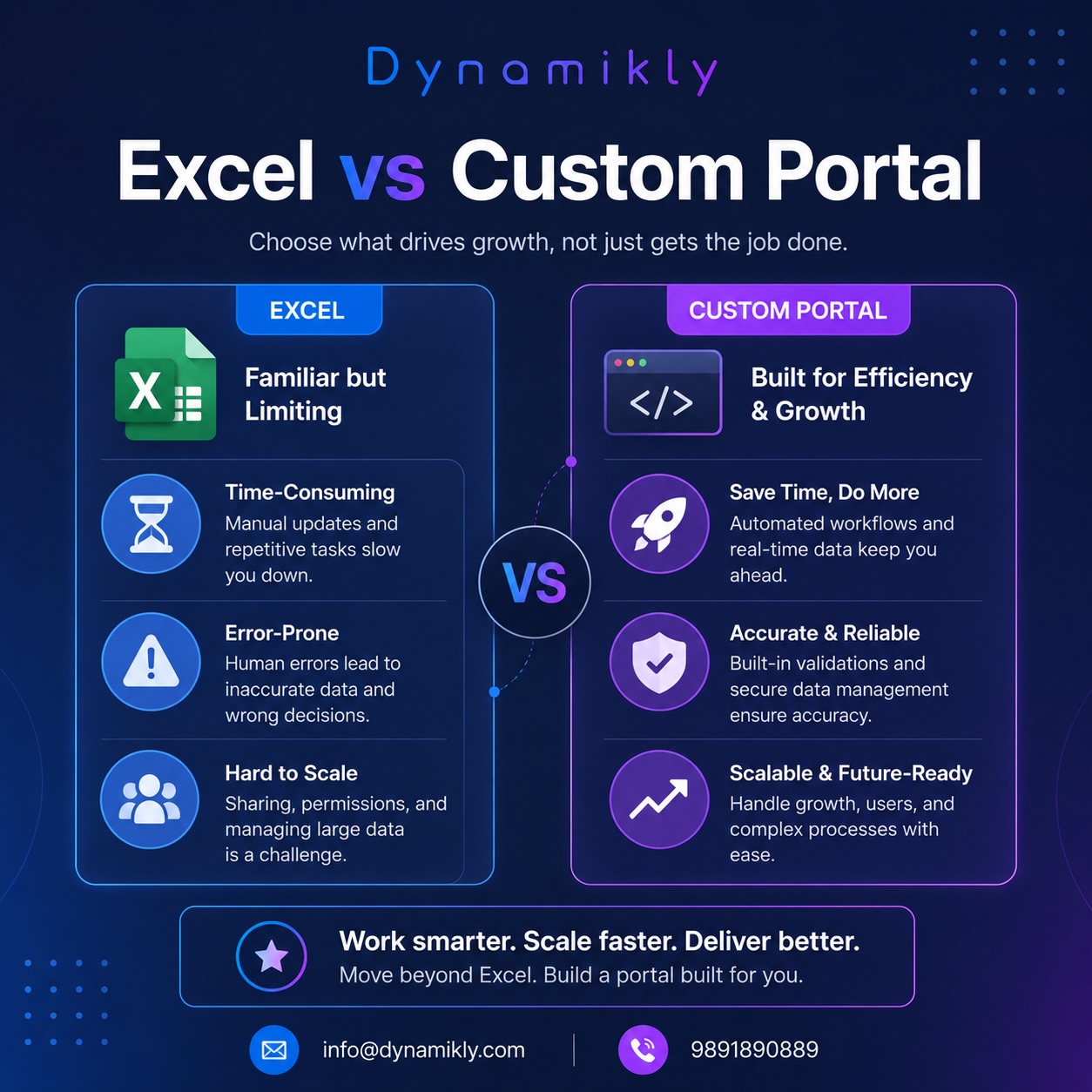
Teams begin working on multiple versions of the same document. Important information becomes scattered across departments. Manual updates consume valuable hours each week. Reporting becomes increasingly difficult, and the risk of errors rises significantly.
What once felt efficient gradually becomes an obstacle to productivity.
The Hidden Limitations of Excel-Based Operations
Increased Manual Work
As data volumes expand, employees spend more time entering information, updating records, and compiling reports. Repetitive administrative tasks divert attention away from strategic initiatives and customer-focused activities.
Greater Risk of Human Error
A misplaced formula, accidental deletion, or outdated version of a spreadsheet can impact critical business decisions. Even minor mistakes may result in financial discrepancies, operational delays, or inaccurate reporting.
Limited Visibility Across the Organization
Decision-makers require timely and accurate insights. When information exists across multiple spreadsheets, obtaining a clear picture of business performance becomes increasingly difficult.
Without centralized reporting, opportunities may be missed and problems may remain unnoticed until they escalate.
Collaboration Challenges
Modern businesses rely on teams working together efficiently. Spreadsheets often create confusion regarding ownership, version control, and accountability.
Questions such as, "Which file is the latest?" or "Who made this change?" become common occurrences that slow progress.
Moving Beyond Spreadsheets
Growing businesses require systems that evolve alongside their operations.
Custom business portals offer a centralized platform designed specifically around the way an organization functions. Rather than adapting business processes to fit generic tools, a tailored solution aligns with existing workflows while creating opportunities for greater efficiency and automation.
A well-designed portal transforms disconnected tasks into streamlined processes.
How Custom Portals Support Business Growth
Operational Efficiency
Automated workflows eliminate repetitive tasks, reduce administrative burden, and allow teams to focus on higher-value responsibilities.
Faster Decision-Making
Real-time dashboards and consolidated reporting provide leaders with immediate access to the information they need to make informed decisions confidently.
Improved Accuracy
Automation minimizes manual intervention, resulting in more reliable data and reducing the likelihood of costly mistakes.
Enhanced Collaboration
Employees work within a unified environment where information is consistently updated and accessible according to their roles and responsibilities.
Stronger Security
Unlike spreadsheets that can easily be copied or shared without oversight, custom portals provide structured access controls, activity tracking, and secure data management practices.
Scalability
As organizations expand, their systems must adapt accordingly. Custom portals can evolve to accommodate new departments, additional users, and changing operational requirements.
What Can a Custom Portal Manage?
Every business has unique needs, but custom portals are commonly used to manage areas such as:
- Customer relationship management
- Lead and inquiry tracking
- Employee and human resource processes
- Inventory and stock management
- Project coordination
- Vendor and supplier interactions
- Billing and invoicing
- Service requests and support management
- Reporting and performance analytics
By consolidating these functions into a single system, businesses gain greater control and operational clarity.
Is Your Business Ready for the Next Stage?
Consider your current processes.
Are employees spending excessive time updating spreadsheets?
Is it becoming difficult to track information accurately?
Do reporting delays affect decision-making?
Has collaboration across teams become more complicated as the business grows?
If these challenges sound familiar, it may be time to evaluate whether your existing systems are supporting your objectives effectively.
Building Systems That Enable Growth
Excel remains a valuable tool for analysis and individual tasks. However, using it as the foundation for an expanding business can eventually limit efficiency, visibility, and scalability.
Organizations that successfully navigate growth invest in systems that simplify operations, strengthen decision-making, and create a solid framework for the future.
Technology should empower businesses to move forward with confidence.
Ready to Move Beyond Excel?
At Dynamikly, we help businesses transition from fragmented processes to streamlined digital solutions tailored to their unique requirements.
Whether you need a customer portal, an internal management system, workflow automation, or a fully customized business platform, our goal is to build technology that supports sustainable growth.
The right systems do more than organize information. They create opportunities for businesses to operate smarter, respond faster, and scale more effectively.
Stop managing spreadsheets. Start building systems designed for growth.
If you're exploring ways to modernize your operations, the Dynamikly team is here to help you identify the right solution for your business.
Ready to streamline your operations and move beyond spreadsheets? Connect with Dynamikly to explore a custom portal built around your business needs.